organic chemistry lab survival manual zubrick
Zubrick’s manual is a hands-on guide, updated for organic chemistry students, focusing on essential techniques, safety, and instrumentation within the laboratory setting.
Overview of the Manual’s Purpose
Zubrick’s Organic Chemistry Lab Survival Manual serves as a comprehensive resource designed to empower students navigating the complexities of the organic chemistry laboratory. Its primary purpose is to bridge the gap between theoretical knowledge and practical application, offering detailed guidance on fundamental techniques. The manual aims to instill confidence in students by providing step-by-step instructions, troubleshooting tips, and crucial safety protocols.
It’s intended to be a practical companion, ensuring students understand not just what to do, but how and why. This guide equips learners with the skills needed for successful experimentation and data interpretation, fostering a deeper understanding of organic chemistry principles.
Target Audience: Students and Instructors
Zubrick’s Organic Chemistry Lab Survival Manual primarily targets students enrolled in sophomore and junior-level organic chemistry courses with a laboratory component. It’s designed for those seeking a practical, accessible guide to essential techniques and safety procedures. However, the manual also proves invaluable to instructors.
It serves as a supplementary resource, reinforcing classroom concepts and providing a standardized reference for lab procedures. Instructors can utilize it to streamline lab preparation, ensure student safety, and promote consistent technique application. The manual’s clarity and detail benefit both learners and educators alike, enhancing the overall lab experience.
Editions and Updates (Focus on Sixth Edition)
Zubrick’s Organic Chemistry Lab Survival Manual has undergone several editions, continually refining its content to reflect advancements in laboratory practices and safety protocols. While earlier editions provided a solid foundation, the Sixth Edition represents a significant update. It incorporates feedback from both students and instructors, ensuring relevance and practicality.
The latest edition likely features revised techniques, updated safety guidelines, and potentially new coverage of emerging instrumentation. It remains a popular choice due to its clear explanations and focus on the fundamental skills needed for success in the organic chemistry lab.
Essential Laboratory Techniques Covered
Zubrick’s manual expertly details core techniques like distillation, extraction, recrystallization, and chromatography, equipping students with practical skills for organic chemistry experiments;
Distillation Techniques
Zubrick’s manual thoroughly covers distillation, a fundamental separation technique in organic chemistry. It differentiates between simple distillation, ideal for liquids with significant boiling point differences, and fractional distillation, employed for mixtures with closer boiling points. The guide explains the principles behind each method, detailing apparatus setup and proper heating control.
Students learn to optimize distillation for purity and yield, understanding concepts like vapor pressure and Raoult’s Law. Zubrick emphasizes careful observation during the process, noting boiling point ranges and identifying potential issues like bumping or incomplete separation. Practical applications, such as purifying solvents or isolating reaction products, are highlighted throughout the explanation.
Simple Distillation Procedure
Zubrick’s manual details a straightforward simple distillation procedure, beginning with proper apparatus assembly – flask, distillation head, condenser, and receiving flask. The mixture is heated, vaporizing the lower-boiling component, which then condenses and is collected.
Zubrick stresses gradual heating to maintain a steady distillation rate and avoid “bumping.” Careful temperature monitoring is crucial, noting the boiling point range of the distillate. The manual emphasizes safe handling of heated glassware and proper disposal of distillation residues. This technique is best suited for separating liquids with boiling point differences exceeding 25°C, ensuring effective purification.
Fractional Distillation: Principles and Applications
Zubrick’s guide explains fractional distillation as an enhanced version of simple distillation, utilizing a fractionating column. This column, packed with glass beads or rings, provides a larger surface area for repeated vaporization and condensation cycles.
Zubrick highlights its effectiveness in separating liquids with closer boiling points (less than 25°C). The manual details careful control of heating rates and reflux ratios to achieve optimal separation. Applications include purifying solvents and separating components of petroleum. Proper column packing and insulation are key for efficiency, as detailed by Zubrick.
Extraction Procedures
Zubrick’s manual thoroughly covers extraction, a crucial technique for isolating desired compounds. He details both liquid-liquid and solid-phase extraction (SPE). Liquid-liquid extraction, as Zubrick explains, relies on differential solubility between two immiscible solvents – typically aqueous and organic.
Zubrick emphasizes proper mixing, settling, and separation of layers. SPE, a more modern technique, utilizes a solid stationary phase to selectively retain compounds. The manual guides students through choosing appropriate solvents and packing materials. Effective extraction, according to Zubrick, is vital for purification and analysis.
Liquid-Liquid Extraction: A Step-by-Step Guide
Zubrick meticulously outlines liquid-liquid extraction, beginning with proper mixing of the aqueous and organic phases in a separatory funnel. He stresses gentle inversion, frequent venting to release pressure, and careful layer separation.
Zubrick details the importance of solvent choice based on solubility and density. Multiple extractions with smaller volumes are favored over a single large extraction for maximizing yield, as Zubrick notes. Drying the organic layer with a desiccant, like magnesium sulfate, is also covered. Finally, Zubrick emphasizes careful solvent removal via evaporation.
Solid-Phase Extraction (SPE) Basics
Zubrick introduces Solid-Phase Extraction (SPE) as a powerful purification technique. He explains the process involves selectively adsorbing target compounds onto a solid sorbent, then eluting them with a suitable solvent.
Zubrick details cartridge conditioning, sample loading, washing to remove impurities, and finally, elution of the desired compound. The choice of sorbent – reversed-phase, normal-phase, or ion-exchange – is crucial, as Zubrick emphasizes, depending on the analyte’s properties. SPE offers advantages over liquid-liquid extraction, including reduced solvent usage and improved selectivity, according to Zubrick.
Recrystallization Methods
Zubrick thoroughly covers recrystallization, a fundamental purification technique. He stresses selecting an appropriate solvent where the compound is soluble when hot but insoluble when cold. Zubrick details dissolving the impure solid in minimal hot solvent, followed by slow cooling to induce crystal formation.
Zubrick emphasizes the importance of impurities remaining dissolved or being filtered out during the process. He also explains hot filtration techniques to remove insoluble impurities before cooling. Proper solvent choice and cooling rate, as Zubrick outlines, are key to obtaining pure, well-formed crystals.
Choosing the Right Solvent for Recrystallization
Zubrick emphasizes that solvent selection is paramount for successful recrystallization. Ideally, the solvent should dissolve the compound when hot and have minimal solubility when cold, maximizing crystal yield. He advises considering the “like dissolves like” principle – polar compounds in polar solvents, and nonpolar in nonpolar.
Zubrick suggests testing several solvents to determine suitability, often starting with a small amount of the solid. A good solvent will allow for complete dissolution upon heating and precipitate the pure compound upon cooling. Zubrick cautions against using a solvent where the compound is readily soluble at all temperatures.
Hot Filtration Techniques
Zubrick’s manual details hot filtration as a crucial purification step during recrystallization, removing insoluble impurities without significant product loss. He stresses preheating all glassware – the funnel, flask, and filtration paper – to prevent premature crystallization on the filter.
Zubrick advises using fluted filter paper to increase filtration rate and prevent clogging. Maintaining a gentle flow rate is vital; rapid filtration can lead to product loss. The filtrate, now clear of insoluble matter, is then allowed to cool slowly, promoting the formation of pure crystals, as Zubrick explains.
Chromatography Fundamentals
Zubrick’s manual thoroughly covers chromatography, highlighting its importance in separating and identifying organic compounds. He details both Thin Layer Chromatography (TLC) and Column Chromatography as essential techniques. TLC, as Zubrick explains, is a quick analytical method for monitoring reaction progress and assessing purity.
Zubrick emphasizes proper plate preparation and solvent selection for optimal separation. Column chromatography, he notes, allows for preparative separation of larger quantities. He stresses careful packing of the column and appropriate eluent choice for effective fractionation, crucial for obtaining pure compounds.
Thin Layer Chromatography (TLC) – Principles and Practice
Zubrick meticulously explains TLC’s principles, emphasizing the differential migration of compounds based on polarity between a stationary phase (silica gel) and a mobile phase (solvent). He details spotting techniques for sample application, stressing the importance of concentrated spots.
Zubrick guides users through developing the TLC plate in a closed chamber to ensure solvent saturation, and visualizing spots using UV light or staining reagents. He highlights calculating Rf values – the distance traveled by the compound divided by the solvent front – for identification and purity assessment, a cornerstone of organic analysis.
Column Chromatography: Packing and Elution
Zubrick provides a detailed walkthrough of column chromatography, starting with proper column packing – creating a homogenous silica gel or alumina bed without air bubbles – crucial for effective separation. He emphasizes slurry preparation and gentle tapping during packing to avoid cracks.
Zubrick then explains solvent selection for elution, based on compound polarity, and techniques for fraction collection. He stresses the importance of TLC monitoring to identify fractions containing the desired product, optimizing separation and maximizing yield. Proper elution techniques are vital for successful purification.
Safety Protocols in the Organic Chemistry Lab
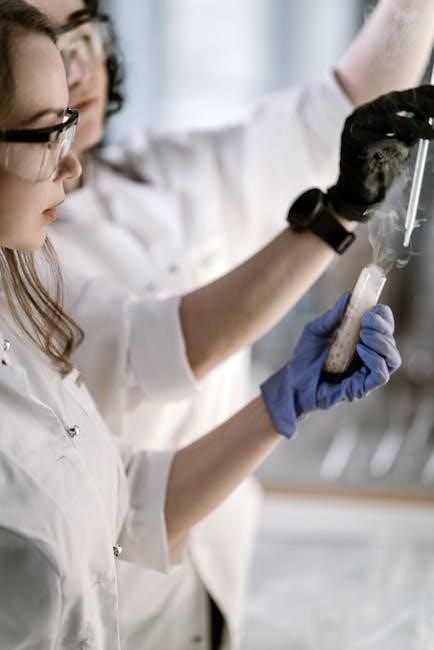
Zubrick emphasizes essential safety protocols, including proper PPE use, careful chemical handling, and strict waste disposal procedures, vital for a secure lab environment.
Personal Protective Equipment (PPE)
Zubrick’s manual strongly advocates for comprehensive personal protective equipment (PPE) in the organic chemistry lab. Eye protection, specifically safety goggles and face shields, is paramount to prevent chemical splashes and injuries. The selection of appropriate gloves is also crucial; the manual details material considerations based on the chemicals being handled, emphasizing proper donning and doffing techniques to avoid contamination;
Beyond these basics, lab coats are essential for body protection, and closed-toe shoes are a non-negotiable requirement. Understanding the limitations of each PPE item and consistently using them correctly are fundamental aspects of lab safety, as highlighted throughout Zubrick’s guide.
Eye Protection: Safety Goggles and Face Shields
Zubrick’s Organic Chemistry Lab Survival Manual emphasizes that eye protection is non-negotiable. Safety goggles, providing a sealed shield, are the primary defense against chemical splashes, projectiles, and fumes. The manual stresses the importance of goggles meeting ANSI Z87.1 standards for impact resistance.
For procedures with a higher risk of splashes or explosions, Zubrick recommends supplementing goggles with a face shield, offering broader facial coverage. Proper fit is critical; goggles must seal snugly around the eyes. Contact lenses are generally discouraged due to potential trapping of chemicals.
Gloves: Material Selection and Proper Use
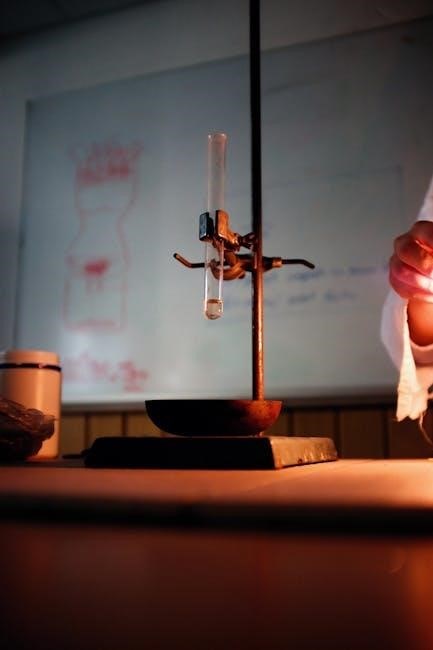
Zubrick’s manual details crucial glove selection based on chemical compatibility. Nitrile gloves are generally recommended for broad protection against common solvents, but aren’t universally resistant. Latex gloves offer dexterity but pose allergy risks. Neoprene or butyl rubber are needed for specific chemicals.
Zubrick stresses checking glove degradation charts before use. Inspect gloves for pinholes or tears before each experiment. Change gloves immediately if contamination occurs. Remove gloves carefully to avoid skin contact with contaminants, and always wash hands thoroughly after removal.
Handling Chemicals Safely
Zubrick’s manual emphasizes meticulous chemical handling procedures for lab safety. Always add acid to water, never water to acid, to avoid violent reactions. Work with flammable solvents away from open flames and heat sources, utilizing proper ventilation.
Zubrick highlights the importance of understanding chemical hazards via Safety Data Sheets (SDS). Never smell or taste chemicals. Use appropriate dispensing tools like pipettes and funnels to prevent spills. Report any spills or accidents immediately to the instructor, following established protocols for cleanup and disposal.
Acid and Base Handling Procedures
Zubrick’s guide stresses always adding acid to water slowly, with stirring, to dissipate heat and prevent splashing – a crucial safety rule. Concentrated acids and bases are corrosive; avoid skin contact by wearing appropriate personal protective equipment (PPE), including gloves and eye protection.
Neutralize spills immediately with appropriate neutralizing agents (baking soda for acids, dilute acetic acid for bases) before cleaning. Zubrick advises careful labeling of all acid and base containers, clearly indicating concentration and hazards. Proper storage, separated from incompatible materials, is also essential.
Flammable Solvent Safety
Zubrick’s manual emphasizes that flammable solvents pose a significant fire hazard in the organic chemistry lab. Always handle these solvents away from open flames, sparks, and heat sources. Ensure adequate ventilation to prevent vapor buildup, as vapors are heavier than air and can travel considerable distances.
Proper grounding and bonding procedures are vital when transferring flammable liquids to avoid static electricity buildup. Zubrick recommends storing solvents in approved flammable liquid storage cabinets. Be prepared with fire extinguishers and understand their proper use; knowing emergency procedures is paramount for lab safety.
Waste Disposal Procedures
Zubrick’s Organic Chemistry Lab Survival Manual stresses the critical importance of proper chemical waste disposal. Segregation is key; halogenated and non-halogenated solvents must be collected separately, as should acids, bases, and solid waste. Never pour chemicals down the drain unless specifically authorized by your instructor.
All waste containers require accurate and complete labeling, detailing the contents and hazards. Zubrick highlights that improper disposal can lead to environmental contamination and safety risks. Follow all institutional guidelines and regulations meticulously, ensuring responsible laboratory practices are always maintained.
Segregation of Chemical Waste
Zubrick’s manual emphasizes that effective waste management begins with careful segregation. Halogenated solvents—those containing chlorine, bromine, or iodine—must be kept entirely separate from non-halogenated counterparts. Acids and bases require distinct containers, preventing potentially dangerous reactions. Solid waste, often contaminated, also needs its own designated receptacle.
This separation prevents unwanted chemical interactions and simplifies the treatment process. Zubrick stresses that mixing incompatible wastes can create hazardous conditions, including fires or the release of toxic gases. Always consult your lab’s specific guidelines for detailed segregation protocols.
Proper Labeling of Waste Containers
Zubrick’s guide highlights the critical importance of accurately labeling all chemical waste containers. Each label must clearly identify the contents, avoiding vague terms like “waste solvent.” Specific chemical names or, at minimum, hazard classifications are essential. Include concentration details when applicable, and never use abbreviations that might be misinterpreted.
Date the container upon initial use, and consistently update it as waste accumulates. Zubrick stresses that proper labeling ensures safe handling, storage, and ultimately, appropriate disposal by qualified personnel. A well-labeled container prevents accidental mixing and facilitates compliance with environmental regulations.
Instrumentation and Equipment
Zubrick’s manual details operation of key instruments like rotovaps, and spectroscopy equipment (UV-Vis, IR), alongside techniques for accurate melting point determination.
Rotary Evaporator (Rotovap) Operation
Zubrick’s manual provides crucial guidance on utilizing the rotary evaporator, a cornerstone of organic chemistry labs. It emphasizes the importance of proper setup, including secure flask attachment and vacuum application. Students learn to control bath temperature and rotation speed for efficient solvent removal.
The manual details troubleshooting common issues like bumping, and the significance of a cold trap to prevent solvent loss and contamination. Understanding these principles ensures safe and effective solvent evaporation, crucial for isolating desired products and preparing samples for further analysis. Proper technique minimizes decomposition and maximizes yield.
Spectroscopy Basics
Zubrick’s manual introduces students to fundamental spectroscopic techniques vital for compound identification. It covers both UV-Vis and Infrared (IR) spectroscopy, explaining their underlying principles and practical applications in the organic chemistry lab. The guide details how UV-Vis spectroscopy reveals information about conjugated systems and concentration, while IR spectroscopy identifies functional groups present in a molecule;
Students learn to interpret spectra, recognizing key peaks and patterns. The manual stresses the importance of sample preparation and proper instrument calibration for accurate results. Understanding these techniques is essential for confirming product identity and assessing reaction success.
Zubrick’s manual explains that UV-Vis spectroscopy measures the absorption of ultraviolet and visible light by a substance. This technique is particularly useful for analyzing compounds containing conjugated systems – alternating single and double bonds – which exhibit strong UV-Vis absorption. The manual details how the wavelength of maximum absorption (λmax) relates to the structure of the molecule.
Applications include quantitative analysis, determining concentrations using Beer-Lambert Law, and monitoring reaction kinetics. Students learn to prepare samples correctly and interpret spectra to identify and quantify compounds. Proper understanding aids in verifying product purity and reaction completion.

Infrared (IR) Spectroscopy: Functional Group Identification
Zubrick’s guide emphasizes IR spectroscopy as a crucial tool for identifying functional groups within organic molecules. The technique relies on measuring the absorption of infrared light, causing molecular vibrations. Different functional groups absorb at characteristic frequencies, creating a unique “fingerprint” on the IR spectrum.
The manual provides correlation tables linking absorption bands to specific functional groups like alcohols (O-H stretch), carbonyls (C=O stretch), and alkenes (C=C stretch). Students learn to analyze spectra, identify key peaks, and deduce the presence or absence of important functional groups, aiding in compound structure elucidation.
Melting Point Determination
Zubrick’s manual details the precise technique of melting point determination, a vital method for assessing compound purity and identity. It stresses proper capillary tube packing – ensuring a tightly packed, small sample – for accurate results. The guide highlights the importance of a slow, controlled heating rate, especially near the anticipated melting point, to observe the initial melt and final solidification.
Students learn to interpret melting point ranges; a sharp range indicates high purity, while a broad range suggests impurities. Zubrick emphasizes careful observation and recording of temperature, providing a reliable indicator of substance characteristics.
Capillary Tube Packing and Heating Rate
Zubrick’s guide meticulously explains capillary tube packing, advocating for a tightly packed, approximately 2-3 mm sample height. This ensures efficient heat transfer and accurate melting point observation. The manual stresses gently tapping the tube to settle the sample, avoiding overpacking or loose filling.
Regarding heating rate, Zubrick advises a slow initial rise to approximately 10°C below the expected melting point, then a significantly slower rate (1-2°C/minute) near the melting point. This careful control allows precise determination of the initial melt and final solidification temperatures, crucial for purity assessment.
Interpreting Melting Point Ranges
Zubrick’s manual emphasizes that a pure compound exhibits a sharp melting point – typically less than 1-2°C. A broader range suggests impurities within the sample. The initial temperature marks the first sign of melting, while the final temperature indicates complete liquefaction.
A depressed melting point, alongside a broadened range, strongly indicates the presence of contaminants. Zubrick details how to carefully observe these changes, correlating them with sample purity. Accurate interpretation, guided by proper technique, is vital for characterizing synthesized or isolated compounds.
Troubleshooting Common Lab Issues
Zubrick’s manual addresses frequent problems like low yields, emulsions during extractions, and crystallization difficulties, offering practical solutions for students facing these challenges.
Low Yields in Reactions
Zubrick’s Organic Chemistry Lab Survival Manual dedicates attention to diagnosing low reaction yields, a common frustration for students. Several factors can contribute, including incomplete reactions due to insufficient reaction time or temperature control.
Loss of product during workup and purification steps, such as transfers or filtration, also significantly impacts yield. The manual emphasizes careful technique to minimize these losses. Furthermore, side reactions consuming reactants or forming unwanted byproducts diminish the desired product’s quantity.
Zubrick stresses meticulous monitoring of reactions and proper stoichiometric calculations to optimize yields, providing students with a systematic approach to problem-solving in the lab.
Emulsions During Extraction
Zubrick’s Organic Chemistry Lab Survival Manual thoroughly addresses the troublesome issue of emulsion formation during liquid-liquid extractions. Emulsions, stable mixtures of immiscible liquids, hinder clean phase separation, leading to product loss and inaccurate results.
The manual details several techniques to break emulsions, including gentle swirling instead of vigorous shaking, adding brine (saturated NaCl solution), or carefully filtering through a plug of cotton or Celite.
Zubrick explains that small amounts of finely dispersed droplets stabilize emulsions, and these methods help coalesce them. Patient and methodical technique, as outlined in the manual, is crucial for successful extractions and avoiding frustrating emulsion problems.
Poor Crystallization
Zubrick’s Organic Chemistry Lab Survival Manual dedicates significant attention to troubleshooting unsuccessful recrystallizations, a common challenge in organic labs. The manual emphasizes the importance of solvent selection – choosing a solvent where the compound is soluble when hot but insoluble when cold is paramount.
Zubrick details techniques like seeding with a small crystal of the pure compound, scratching the flask’s interior to induce nucleation, and slow cooling to promote crystal formation.
The manual also cautions against using excessively hot solvent or cooling too rapidly, both of which can hinder proper crystal growth. Careful execution of these techniques, as Zubrick guides, maximizes product purity and recovery.